
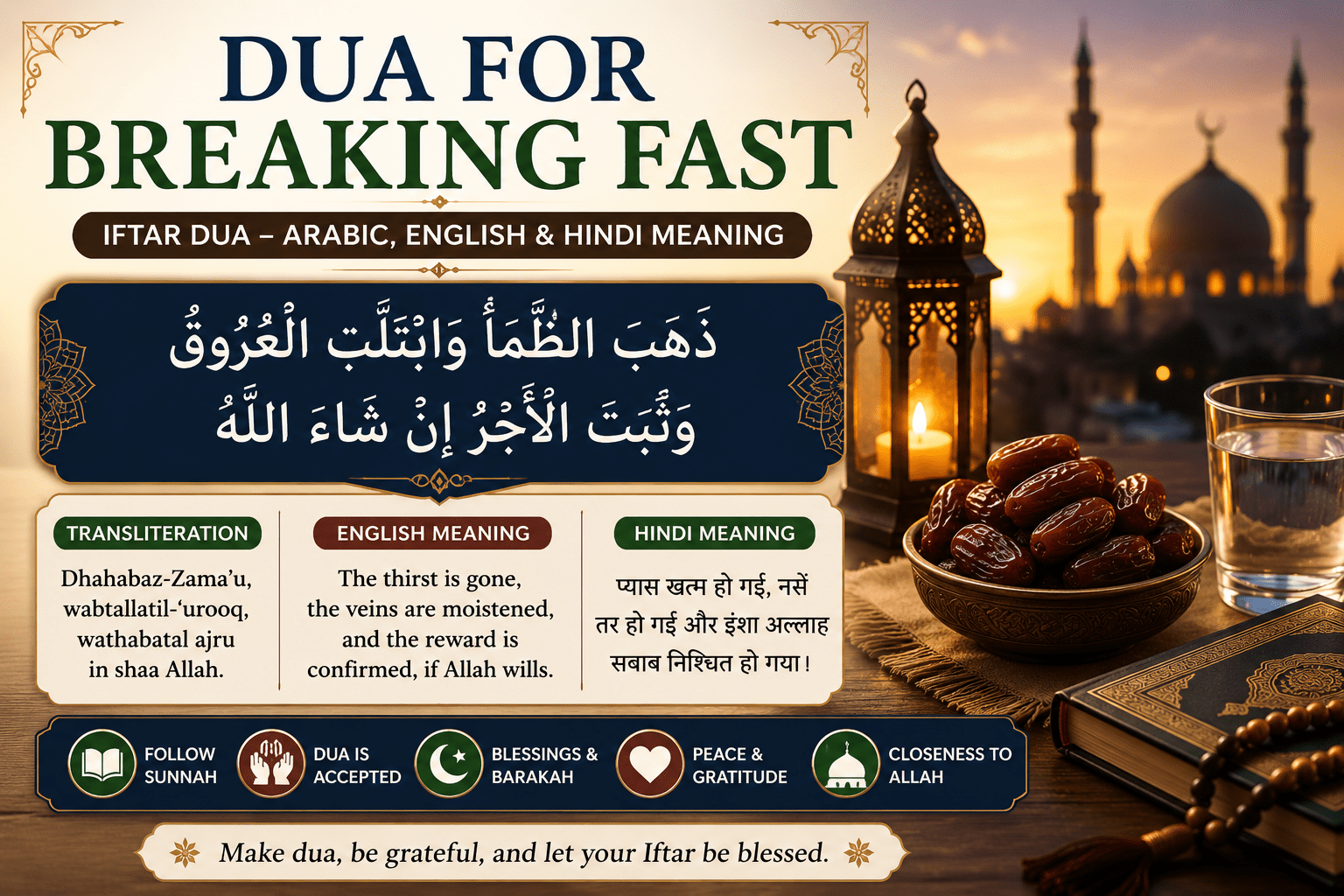
What is the Dua for Breaking Fast?
The authentic dua recited when breaking the fast is:
Arabic
ذَهَبَ الظَّمَأُ وَابْتَلَّتِ الْعُرُوقُ وَثَبَتَ الْأَجْرُ إِنْ شَاءَ اللَّهُ
Transliteration
Dhahabaz-Zama’u wabtallatil-‘urooqu wa thabatal-ajru in shaa Allah.
English Meaning
“The thirst has gone, the veins are moistened, and the reward is confirmed, if Allah wills.”
Hindi Meaning
“प्यास खत्म हो गई, नसें तर हो गईं और इंशाअल्लाह सवाब निश्चित हो गया।”
Introduction
Dua for Breaking Fast (Iftar Dua) is one of the most beautiful supplications in Islam. The moment of Iftar is a blessed time when Muslims end their fast after a day of worship, patience, and devotion to Allah.
Islam teaches that the dua of a fasting person is accepted, especially at the time of breaking the fast. Therefore, every Muslim should remember Allah, express gratitude, and make sincere duas before and after Iftar.
This article explains the authentic dua for breaking fast in Arabic, English, and Hindi, its meaning, benefits, importance, and answers the most common questions.
Authentic Dua for Breaking Fast
Arabic
ذَهَبَ الظَّمَأُ وَابْتَلَّتِ الْعُرُوقُ وَثَبَتَ الْأَجْرُ إِنْ شَاءَ اللَّهُ
Transliteration
Dhahabaz-Zama’u wabtallatil-‘urooqu wa thabatal-ajru in shaa Allah.
English Translation
“The thirst has gone, the veins are moistened, and the reward is established, if Allah wills.”
Hindi Translation
“प्यास चली गई, शरीर को ताजगी मिल गई और अल्लाह चाहे तो रोज़े का सवाब पक्का हो गया।”
Another Famous Iftar Dua
Arabic
اللَّهُمَّ إِنِّي لَكَ صُمْتُ وَبِكَ آمَنْتُ وَعَلَيْكَ تَوَكَّلْتُ وَعَلَى رِزْقِكَ أَفْطَرْتُ
Transliteration
Allahumma inni laka sumtu wa bika aamantu wa ‘alayka tawakkaltu wa ‘ala rizqika aftartu.
English Meaning
“O Allah! I fasted for You, I believe in You, I trust in You, and with Your provision I break my fast.”
Hindi Meaning
“ऐ अल्लाह! मैंने तेरे लिए रोज़ा रखा, तुझ पर ईमान लाया, तुझ पर भरोसा किया और तेरी दी हुई रोज़ी से अपना रोज़ा खोला।”
Why Is Dua Important at Iftar Time?
The time of Iftar is among the most blessed moments of the day. A fasting person spends hours controlling desires, avoiding food and drink, and obeying Allah.
Benefits include:
- Allah’s mercy descends.
- Duas are more likely to be accepted.
- Gratitude increases.
- Faith becomes stronger.
- Sins may be forgiven.
- Heart becomes peaceful.
- Connection with Allah grows.
When Should You Read the Iftar Dua?
Many Muslims ask:
Before Eating or After Eating?
The commonly accepted practice is:
- Break the fast with dates or water.
- Recite the authentic dua.
- Thank Allah for completing the fast.
- Continue making personal duas.
Sunnah of Breaking Fast
The Prophet Muhammad ﷺ encouraged Muslims to:
1. Break Fast Quickly
Do not delay Iftar after sunset.
2. Use Dates
Start with fresh or dry dates.
3. Drink Water
If dates are unavailable.
4. Make Dua
Use the blessed moments around Iftar.
5. Thank Allah
Show gratitude for food and health.
Powerful Personal Duas at Iftar
For Forgiveness
Arabic
اللهم اغفر لي ذنوبي كلها
English
“O Allah, forgive all my sins.”
Hindi
“ऐ अल्लाह! मेरे सभी गुनाह माफ़ फरमा।”
For Rizq
Arabic
اللهم ارزقني رزقاً حلالاً طيباً
English
“O Allah, grant me lawful and blessed sustenance.”
Hindi
“ऐ अल्लाह! मुझे हलाल और बरकत वाली रोज़ी अता फरमा।”
For Health
Arabic
اللهم اشفني شفاءً لا يغادر سقماً
English
“O Allah, grant me complete healing.”
Hindi
“ऐ अल्लाह! मुझे पूर्ण शिफा अता फरमा।”
Benefits of Reading Dua for Breaking Fast
Spiritual Benefits
- Increases Taqwa.
- Strengthens Iman.
- Encourages gratitude.
- Brings inner peace.
- Improves patience.
Personal Benefits
- Reduces stress.
- Creates positivity.
- Improves self-discipline.
- Strengthens family bonds during Iftar.
Rewards in Islam
- Following the Sunnah.
- Receiving Allah’s blessings.
- Gaining rewards for remembrance.
- Increasing closeness to Allah.
Common Mistakes During Iftar
Avoid:
- Delaying Iftar unnecessarily.
- Forgetting to make dua.
- Wasting food.
- Overeating.
- Missing Maghrib prayer.
- Focusing only on food instead of worship.
Best Time for Accepted Dua
Some of the best times include:
- During fasting.
- Just before Iftar.
- While breaking the fast.
- During Tahajjud.
- Between Adhan and Iqamah.
- After obligatory prayers.
- On Fridays.
FAQs About Dua for Breaking Fast
1. What is the authentic dua for breaking fast?
Dhahabaz-Zama’u wabtallatil-‘urooqu wa thabatal-ajru in shaa Allah.
2. Is Iftar dua compulsory?
No, but it is Sunnah and highly recommended.
3. Can I make dua in my own language?
Yes. Allah understands all languages.
4. When should I read the dua?
At the time of breaking the fast.
5. Are duas accepted at Iftar?
Yes, it is among the blessed times for dua.
6. What should I eat first at Iftar?
Dates are preferred according to Sunnah.
7. Can children recite the Iftar dua?
Yes, children should be encouraged to learn it.
8. Is water enough to break the fast?
Yes, if dates are not available.
9. Can women recite the dua?
Yes, absolutely.
10. Can I ask for worldly needs at Iftar?
Yes, you may ask Allah for both worldly and spiritual needs.
11. Is there a special dua before Iftar?
You may make any sincere dua before Iftar.
12. Does fasting increase the chance of dua acceptance?
Yes, fasting is a blessed act of worship.
13. Can I read the dua from my phone?
Yes.
14. What if I forget the dua?
Make any sincere dua to Allah.
15. What is the reward for following the Sunnah of Iftar?
Great blessings and rewards from Allah.
Conclusion
The Dua for Breaking Fast is a beautiful Sunnah that reminds Muslims to thank Allah after completing their fast. Whether you recite the authentic Iftar dua, ask for forgiveness, health, family blessings, or success, the moments around Iftar are among the most powerful times for supplication.
Recite the dua with sincerity, follow the Sunnah of Prophet Muhammad ﷺ, and trust Allah’s wisdom and mercy. May Allah accept our fasts, prayers, and good deeds. AMEN.