
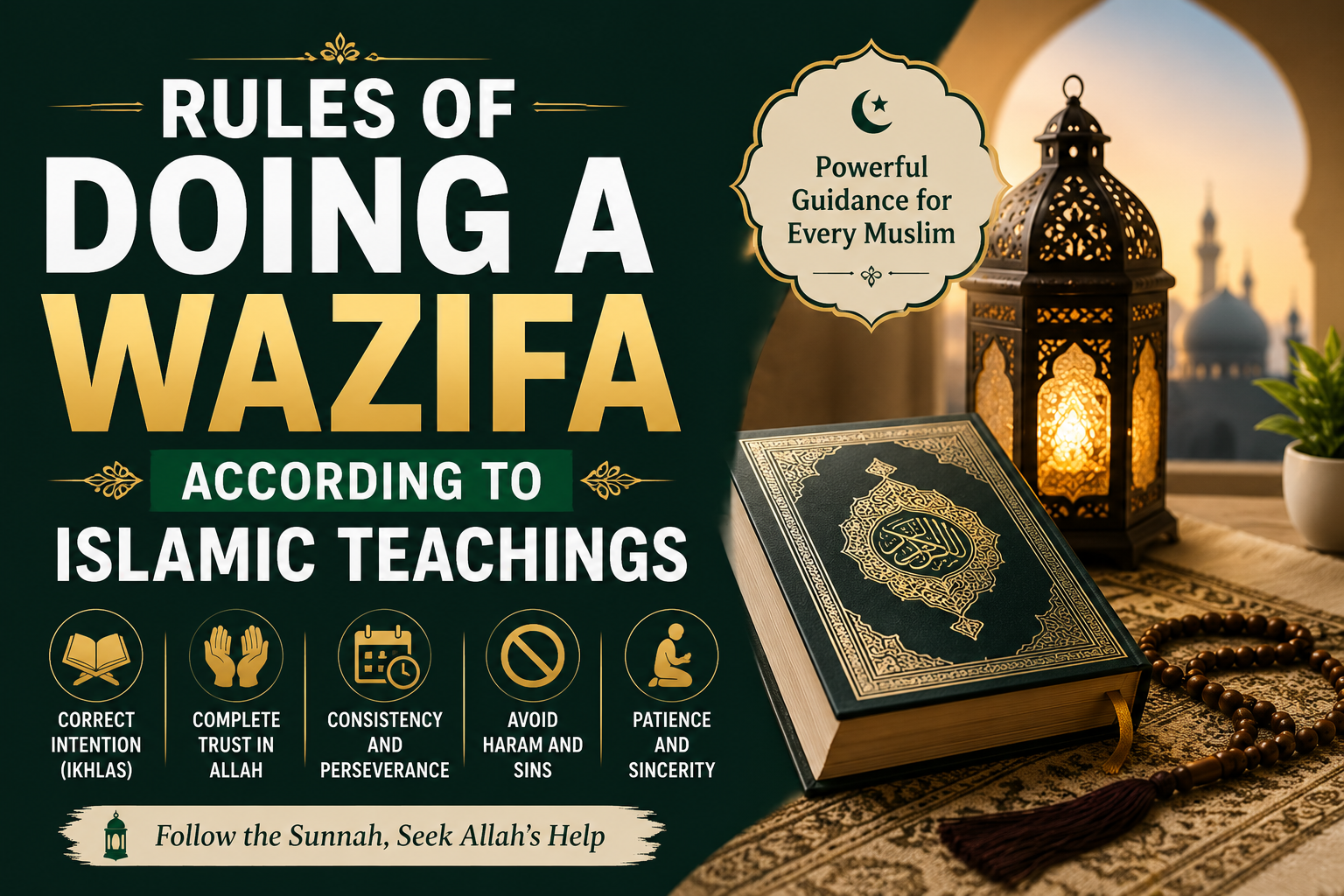
A wazifa generally refers to the regular recitation of Quranic verses, duas, dhikr, or other prescribed supplications for seeking Allah’s help, guidance, mercy, or blessings. Muslims may turn to a wazifa during difficult circumstances, while making dua for a particular need, or as part of their regular worship.
However, a wazifa should never be treated as a magical formula that guarantees a particular outcome. Its purpose is to help a believer remember Allah, strengthen faith, and seek His help while following Islamic principles. Before you start reading a wazifa, it is important to understand the basic guidelines surrounding worship, sincerity, cleanliness, prayer, and lawful conduct.
Below are important rules of doing a wazifa according to Islamic teachings, along with some cautions about claims that are not established as universal Islamic requirements.
1. Make Sure Your Purpose Is Halal
Before beginning any wazifa, consider the reason behind it. The purpose should be permissible according to Shariah.
A person should not perform a wazifa to harm another individual, take away someone’s rights, encourage something forbidden, or achieve an unlawful objective. Your intention should be sincere, and your request should be something that is halal.
2. Recite the Wording Correctly
Correct pronunciation is important, particularly when reciting Quranic verses or established Arabic duas. Changing words or pronunciation can sometimes change their meaning.
Take time to learn the correct pronunciation before beginning. If you are unsure, consult a qualified Quran teacher or knowledgeable scholar rather than relying entirely on an online transliteration.
3. Do Not Neglect the Five Daily Prayers
One of the most important principles is not to allow a wazifa to replace or overshadow Salah. The five daily prayers are obligatory for Muslims who are required to perform them.
A person should not focus on voluntary recitations while deliberately neglecting obligatory worship. Wazifa should complement your relationship with Allah rather than become an excuse to overlook your religious responsibilities.
4. Seek Halal Income
Halal earning is an important part of Islamic life. Muslims should make an effort to ensure that their income and food are lawful.
Instead of making absolute claims that a single amount of unlawful income means that no dua or worship will ever be accepted, it is better to understand the principle correctly: unlawful earnings and consumption are serious matters that can become barriers to the acceptance of supplication.
Therefore, review your sources of income and seek Allah’s forgiveness for anything unlawful.
5. Be Consistent With Your Wazifa
Consistency can help turn remembrance into a meaningful spiritual habit. If a particular wazifa has a prescribed number or schedule based on reliable Islamic evidence, follow that instruction.
However, there is no general Islamic rule that every wazifa must be performed at the same time and place every day. If you need to move or your circumstances change, Allah knows your situation.
The important thing is sincerity, regularity, and following authentic guidance.
6. Maintain Cleanliness
Cleanliness is highly valued in Islam. Performing Wudu before reciting Quran and making dua is a good practice, although Wudu is not universally required for every form of dhikr or dua.
If you are reciting Quran from a physical Mushaf, additional rulings regarding ritual purity apply according to the Islamic school of thought you follow.
Keeping your body, clothing, and surroundings clean can also help you approach worship with greater respect and concentration.
7. Dress Appropriately
Muslims should observe Islamic standards of modesty in their daily lives and especially when engaging in worship.
Men and women should observe the appropriate requirements of covering the awrah during Salah. For other forms of dua or dhikr, the specific rulings can differ, but modest and respectful clothing is always appropriate.
8. Choose a Peaceful Place
Performing a wazifa in a quiet place can make it easier to concentrate. If possible, choose a clean and peaceful area where you are unlikely to be interrupted.
However, being completely alone is not a universal requirement for every wazifa. Unless a particular practice has reliable evidence requiring privacy, it should not be presented as an obligatory Islamic condition.
9. Avoid Distractions
When making dua or reciting Quran and dhikr, try to give your attention to Allah. Turn off unnecessary notifications, put your phone aside, and avoid conversations during your recitation.
The goal is to develop khushu, sincerity, and concentration rather than simply repeating words without understanding or reflection.
10. Avoid Sinful Speech and Behaviour
A believer should strive to avoid lying, backbiting, slander, and other sinful behaviour at all times—not merely while performing a wazifa.
If you are trying to improve your relationship with Allah, use the practice as an opportunity to improve your character as well. Repentance should be accompanied by a genuine effort to leave sinful habits.
11. Begin With Repentance
Before making a special dua or starting a devotional routine, seeking Allah’s forgiveness is a beautiful practice.
You may perform Salat al-Tawbah and sincerely ask Allah to forgive your mistakes. Tawbah involves recognising the wrong, regretting it, seeking forgiveness, and making a sincere effort not to return to the sin.
This approach is more important than relying on a particular formula or ritual.
12. Do Not Treat Wazifa as Magic
Perhaps the most important rule is to remember that a wazifa does not independently produce results. Allah alone controls outcomes.
There is no sound basis for guaranteeing that a particular wazifa will work “like a bullet” or that it must produce a specific result within a particular period.
Similarly, claims that every dua must pass through a particular chain of spiritual authorities before Allah accepts it should not be presented as established Islamic doctrine without strong evidence.
13. Have Patience and Tawakkul
Sometimes a person expects an immediate answer after performing a wazifa. When the desired result does not appear quickly, they may become disappointed.
Islam teaches believers to have sabr and tawakkul. Continue making dua while trusting Allah’s wisdom. Acceptance does not necessarily mean receiving exactly what you requested at the exact time you expected.
Allah knows what is best for His servants.
14. Do Not Become Obsessed With Results
Avoid repeatedly asking, “Why is my wazifa not working?” Instead, focus on worship, dua, repentance, and trust in Allah.
A dua may be answered in different ways. A believer may receive what they requested, have a difficulty removed, or receive a reward in the Hereafter. Therefore, worship should not become dependent solely on obtaining a desired worldly result.
15. Avoid Unverified Conditions
Not every condition attached to a wazifa is automatically an Islamic requirement. For example, sleeping on the floor, using a particular perfume, never shaving for a certain period, or following a particular sleeping position should not be described as universal rules of Islam unless supported by reliable evidence.
Likewise, there is no general rule that a person cannot perform two different permissible acts of dua or dhikr at the same time.
16. Follow Authentic Islamic Guidance
The safest approach is to distinguish between Quranic supplications, authentic Sunnah duas, general dhikr, and practices for which there is no reliable evidence.
If a wazifa contains Quranic verses or an authentic dua, learn its meaning and recite it sincerely. If it contains unusual conditions or promises guaranteed results, ask a qualified scholar for guidance before accepting those claims.
Final Thoughts
The most important rules of doing a wazifa are rooted in sincere worship: maintain your obligatory Salah, seek halal earnings, avoid sinful behaviour, make sincere Tawbah, recite Quran and duas correctly, and place your trust in Allah.
A wazifa should never be viewed as a guaranteed method for controlling a particular outcome. Instead, approach it as an opportunity to remember Allah and ask Him for what is good. Keep your intentions sincere, remain patient, and understand that Allah’s wisdom is greater than our expectations.
Most importantly, do not let a voluntary wazifa distract you from obligatory acts of worship. Salah, Tawheed, sincere repentance, halal living, good character, and reliance upon Allah should remain at the heart of a Muslim’s spiritual life.