
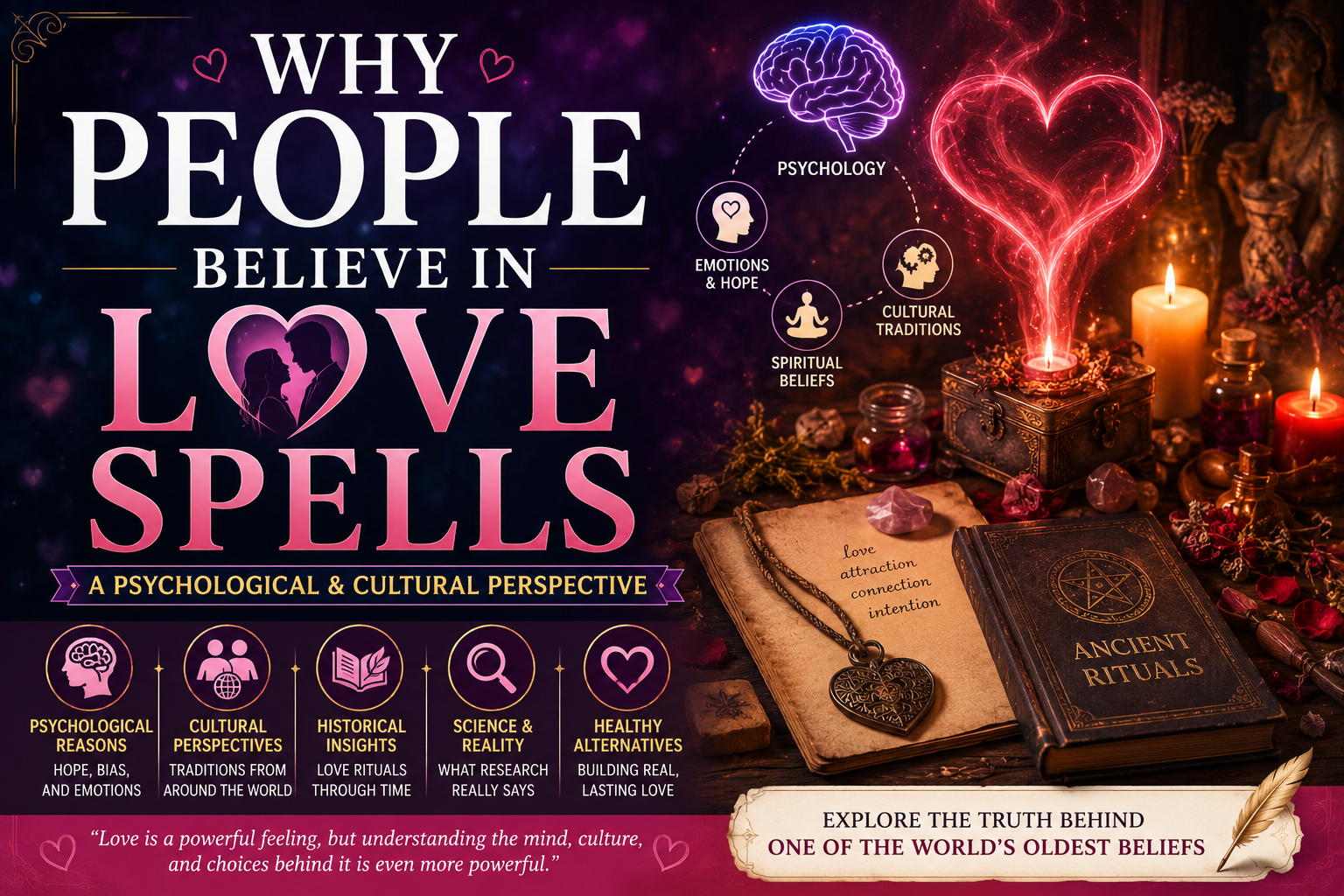
Throughout history, people have searched for ways to find love, repair broken relationships, or strengthen emotional connections. During my research, I discovered that the enduring belief in why people believe in love spells is influenced by a combination of cultural traditions, spiritual beliefs, emotional experiences, and psychological factors. While many people sincerely believe these practices work, there is no reliable scientific evidence that love spells can make a specific person develop genuine romantic feelings. Understanding why these beliefs exist helps me approach the topic with greater empathy, curiosity, and critical thinking.
Love has always been one of the strongest human emotions. It brings happiness, hope, excitement, and sometimes heartbreak. When relationships become difficult or uncertain, it is natural for people to search for answers. Across different cultures and historical periods, love spells have often been viewed as one possible solution.
Some people see love spells as spiritual rituals, while others view them as cultural traditions passed down through generations. Others approach them with skepticism or consider them symbolic rather than literal.
In this guide, I explore why belief in love spells remains common, what psychology says about these beliefs, how different cultures have understood them, and what healthier approaches can support meaningful relationships.
What Are Love Spells?
Love spells are rituals, ceremonies, prayers, charms, or symbolic practices that people in different cultures have believed could influence romantic relationships or attract love.
The exact form of a love spell depends on cultural and historical traditions. Some involve spoken words or symbolic objects, while others are connected to folklore or spiritual customs.
It is important to recognize that these practices are interpreted differently around the world. Some communities consider them meaningful spiritual traditions, while others discourage them or regard them as folklore.
There is no reliable scientific evidence demonstrating that love spells can cause a particular individual to develop genuine romantic feelings.
Why Have Love Spells Existed for So Long?
Throughout history, people often turned to rituals when facing uncertainty.
Love, like health or good fortune, was an area where many hoped spiritual practices might provide comfort or guidance.
Historical Reasons
| Reason | Explanation |
|---|---|
| Emotional uncertainty | Seeking hope during difficult times |
| Cultural traditions | Customs passed through generations |
| Spiritual beliefs | Expressions of faith or folklore |
| Symbolism | Rituals representing hope and intention |
Skimmable Summary
Love spells have appeared in many cultures as rituals or traditions connected to romance. Their meanings vary widely, and beliefs about their effectiveness differ across communities.
Why Do People Believe in Love Spells?
Belief in love spells is often shaped by emotional experiences as much as by cultural or spiritual traditions.
Hope During Heartbreak
When someone experiences rejection or loss, they may look for ways to regain hope or feel that they can take positive action.
Cultural Traditions
In some communities, stories about love rituals have been shared for generations, making them a familiar part of local culture or folklore.
Spiritual Beliefs
Some individuals interpret rituals as expressions of prayer, intention, or spiritual practice, while others view them symbolically.
Personal Experiences
People sometimes describe experiences that they believe support their beliefs. Personal stories can be meaningful to those who experience them, although they do not establish that a practice works in general.
Desire for Certainty
Love often involves uncertainty. Rituals can provide structure and a sense of control during emotionally challenging situations.
Reasons People Believe
| Reason | Why It Appeals |
|---|---|
| Hope | Provides emotional comfort |
| Tradition | Connects with cultural heritage |
| Spiritual meaning | Reflects personal beliefs |
| Personal experiences | Reinforces individual convictions |
| Uncertainty | Offers a sense of direction |
Skimmable Summary
People believe in love spells for many reasons, including hope, tradition, spiritual beliefs, personal experiences, and the desire for certainty during emotional uncertainty.
What Does Psychology Say About Belief in Love Spells?
Psychology offers several explanations for why people may sincerely believe that rituals or symbolic practices influence events.
Confirmation Bias
People naturally remember experiences that support existing beliefs while paying less attention to experiences that do not.
The Placebo Effect
Positive expectations can influence how someone feels emotionally. Feeling more hopeful or confident may change behavior, even if a ritual itself has no direct effect.
Pattern Recognition
Humans naturally look for connections between events. When something positive happens after a ritual, it is easy to assume the ritual caused the outcome.
Emotional Coping
Rituals can provide comfort, reduce anxiety, and help people feel more emotionally grounded during stressful situations.
Increased Confidence
Believing that positive change is possible may encourage someone to communicate more openly, take healthy social risks, or approach relationships with greater optimism.
Psychological Concepts
| Concept | Explanation |
|---|---|
| Confirmation bias | Remembering supportive experiences |
| Placebo effect | Expectations influence emotions |
| Pattern recognition | Seeing connections between events |
| Emotional coping | Managing stress and uncertainty |
| Confidence | Encouraging positive behavior |
Skimmable Summary
Psychology suggests that hope, expectations, emotional coping, and natural thinking patterns can help explain why many people sincerely believe in love spells, even though they do not demonstrate that such rituals can create another person’s romantic feelings.
How Have Different Cultures Viewed Love Spells?
Throughout history, nearly every civilization has developed stories, rituals, or traditions related to love and relationships. While the practices differ, they often reflect the same human desire for companionship, commitment, and emotional security.
Ancient Civilizations
Historical records from ancient Egypt, Greece, and Rome describe charms, amulets, and rituals that some people believed could attract love or strengthen relationships.
These practices were closely connected to the religious and cultural beliefs of their time.
Folk Traditions
Across Europe, Asia, Africa, and the Middle East, local folklore often included symbolic rituals associated with romance and marriage.
Many of these traditions were passed from one generation to another and became part of community customs.
Religious Perspectives
Major world religions generally encourage people to seek healthy relationships through prayer, moral character, patience, and mutual commitment rather than attempting to control another person’s choices.
For many believers, spiritual practices focus on seeking wisdom, guidance, and blessings instead of influencing someone else’s emotions.
Modern Perspectives
Today, people view love spells in many different ways.
Some see them as:
- Cultural heritage.
- Spiritual symbolism.
- Personal rituals.
- Entertainment.
- Historical traditions.
Others remain skeptical and prefer evidence-based approaches to relationships.
Cultural Perspectives on Love Spells
| Perspective | Description |
|---|---|
| Ancient traditions | Rituals connected to local beliefs |
| Folk customs | Community practices passed through generations |
| Religious viewpoints | Emphasis on prayer, ethics, and free choice |
| Modern views | Symbolic, historical, or personal interpretations |
Skimmable Summary
Different cultures have interpreted love spells in different ways. While some traditions value them symbolically or spiritually, many modern perspectives emphasize healthy relationships built on mutual respect and personal choice.
Can Love Spells Actually Create Love?
This is one of the most common questions people ask.
Based on current scientific knowledge, there is no reliable evidence that love spells can cause a specific person to develop genuine romantic feelings.
Love is a complex human experience influenced by many factors, including:
- Mutual attraction.
- Trust.
- Shared values.
- Communication.
- Respect.
- Emotional compatibility.
- Personal choice.
While rituals may help some individuals feel calmer, more hopeful, or more confident, these effects do not demonstrate that another person’s feelings have been changed.
What Research Suggests
| Claim | Current Understanding |
|---|---|
| Love can be magically created | No reliable scientific evidence |
| Confidence can improve attraction | Supported by psychological research |
| Healthy communication matters | Strong evidence |
| Mutual consent is essential | Fundamental to healthy relationships |
Skimmable Summary
Current evidence does not support the idea that love spells create genuine romantic feelings. Healthy relationships develop through mutual interest, trust, communication, and freely chosen commitment.
What Are Healthier Alternatives to Love Spells?
Instead of searching for guaranteed romantic outcomes, I believe it is more helpful to focus on habits that strengthen my own ability to build meaningful relationships.
Develop Self-Confidence
Confidence grows through:
- Learning new skills.
- Setting personal goals.
- Practicing self-care.
- Building healthy friendships.
Improve Communication
Healthy relationships depend upon honest conversations and respectful listening.
Practice Emotional Intelligence
Understanding my own emotions helps me respond with patience, empathy, and maturity.
Build Genuine Connections
Instead of trying to force outcomes, I focus on creating authentic friendships and relationships based on trust and shared values.
Seek Spiritual Guidance
For people of faith, prayer, reflection, and seeking God’s guidance can provide peace and wisdom while respecting everyone’s freedom to choose.
Healthy Relationship Habits
| Habit | Benefit |
|---|---|
| Self-confidence | Builds healthy self-esteem |
| Honest communication | Encourages trust |
| Emotional maturity | Improves relationships |
| Shared values | Supports long-term compatibility |
| Prayer and reflection | Offers guidance and peace |
Skimmable Summary
Healthy relationships are more likely to grow through confidence, communication, emotional maturity, shared values, and sincere spiritual guidance than through attempts to control another person’s feelings.
What Can I Learn From the Popularity of Love Spells?
One of the most interesting lessons is that the popularity of love spells reflects something universal about human nature.
Most people are not simply searching for magic.
They are searching for:
- Love.
- Security.
- Acceptance.
- Hope.
- Lasting companionship.
Understanding this helps me respond with empathy instead of judgment.
Whether someone believes in love spells, views them as cultural traditions, or approaches them with skepticism, the underlying desire is usually the same: to experience genuine love and meaningful connection.
Recognizing this common human experience encourages more compassionate conversations about relationships and emotional well-being.
Skimmable Summary
The lasting popularity of love spells reflects the universal human desire for love, hope, and connection rather than proving that such practices influence another person’s emotions.
Conclusion
Understanding why people believe in love spells requires looking beyond the rituals themselves. History, culture, spirituality, psychology, and personal experiences all contribute to these beliefs.
Throughout my research, I found that love spells often provide people with hope during uncertain times. Cultural traditions, symbolic rituals, and emotional experiences can offer comfort, while psychological factors such as confirmation bias, expectation, and emotional coping help explain why many individuals sincerely believe these practices are effective.
At the same time, current scientific evidence does not support the claim that love spells can create genuine romantic feelings or override another person’s free choice. Lasting relationships are built through mutual respect, trust, communication, compatibility, and freely given commitment.
For me, the most valuable lesson is that healthy love begins with personal growth, empathy, honest communication, and respect for another person’s autonomy. Whether someone approaches relationships through faith, culture, or psychology, focusing on kindness, emotional maturity, and authentic connection creates a stronger foundation for lasting happiness.
Frequently Asked Questions
Why do people believe in love spells?
People believe in love spells for many reasons, including cultural traditions, spiritual beliefs, personal experiences, hope during emotional difficulties, and psychological factors such as expectation and confirmation bias.
Are love spells scientifically proven?
No. There is no reliable scientific evidence demonstrating that love spells can make a specific person develop genuine romantic feelings.
What does psychology say about love spells?
Psychology suggests that cognitive biases, emotional coping, increased confidence, and pattern recognition can influence why people believe rituals are effective.
Can rituals improve confidence?
Yes. Personal rituals can sometimes help people feel calmer or more confident, but this does not mean they can control another person’s emotions.
Have love spells existed throughout history?
Yes. Historical records show that many ancient civilizations and cultures practiced symbolic rituals related to love, courtship, and marriage.
Do all cultures view love spells the same way?
No. Beliefs vary widely. Some traditions treat them as cultural folklore, others as spiritual practices, while many people regard them as symbolic or historical customs.
Can someone be forced to fall in love?
Healthy love cannot be forced. Genuine relationships depend on mutual attraction, trust, communication, compatibility, and each person’s freedom to choose.
What are healthier alternatives to love spells?
Healthy alternatives include building self-confidence, improving communication, developing emotional intelligence, forming genuine relationships, and seeking spiritual guidance according to one’s beliefs.
Why are love spells still popular today?
They remain popular because they offer hope, emotional comfort, and a sense of control during uncertain or difficult relationship situations, even though their claimed effects are not supported by reliable scientific evidence.
What is the biggest lesson about love spells?
The biggest lesson is that people are often searching for love, hope, and connection. Lasting relationships are most likely to grow through mutual respect, trust, communication, personal growth, and freely chosen commitment rather than attempts to influence another person’s feelings.