
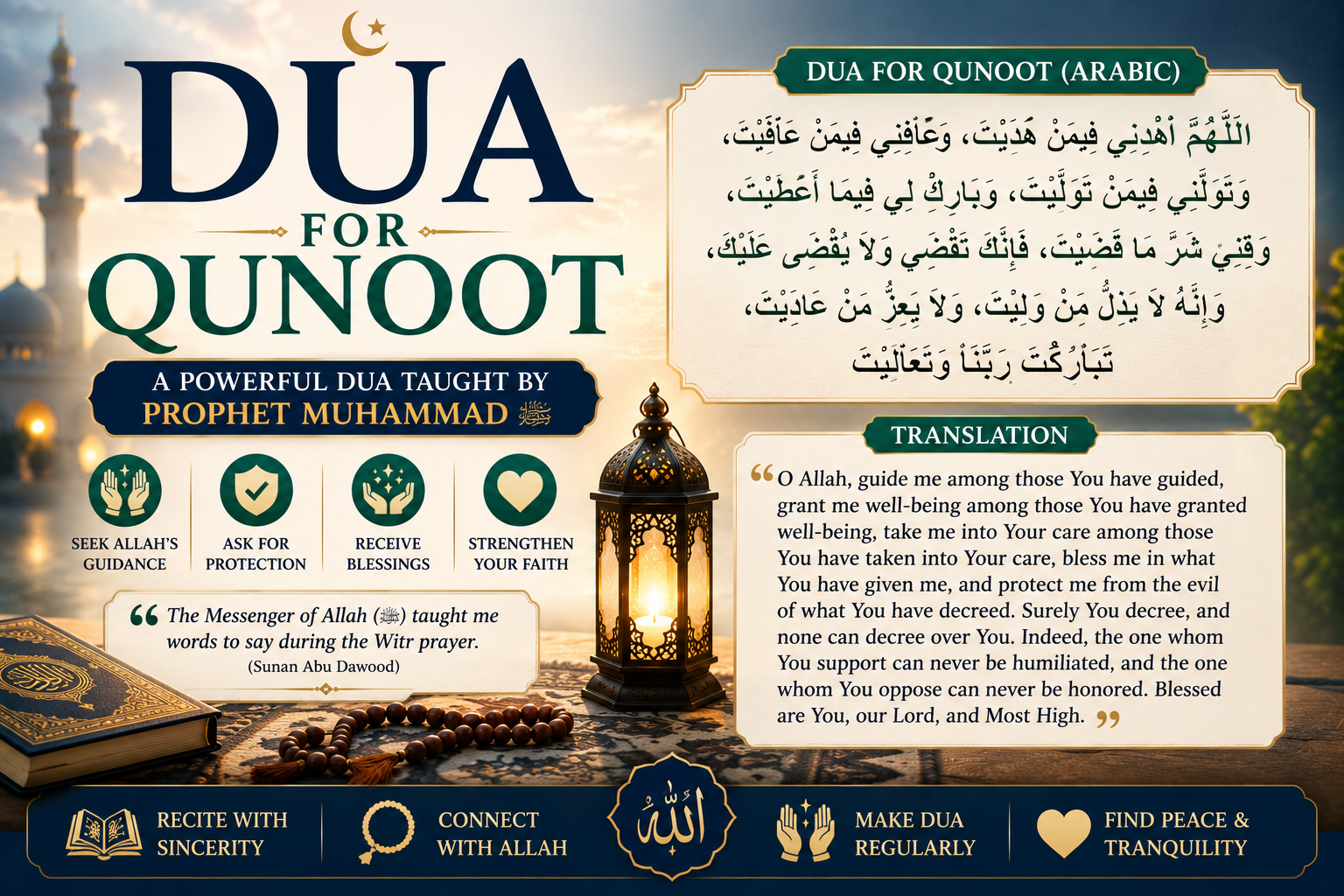
Dua for Qunoot is one of the most beautiful and meaningful supplications in Islam. It is commonly recited during the Witr prayer, especially in the final rak’ah, as Muslims humble themselves before Allah (SWT), seeking His guidance, mercy, forgiveness, and protection. I find that reciting Dua for Qunoot reminds me of my complete dependence upon Allah. Every word of this supplication reflects humility, trust, and hope in His infinite mercy. Whether you are learning it for the first time or looking to understand its meaning more deeply, this guide will explain the Arabic text, transliteration, translation, virtues, and the proper way to recite it according to authentic Islamic teachings.
The Prophet Muhammad ﷺ regularly taught his companions authentic supplications, and Dua for Qunoot is among the most well-known. It is a comprehensive dua that asks Allah for guidance, well-being, blessings, protection, and acceptance.
In this article, I will explain the significance of Dua for Qunoot, when it is recited, its authentic wording, and why every Muslim should strive to understand and memorise this beautiful supplication.
What Is Dua for Qunoot?
The word Qunoot (القنوت) refers to humility, devotion, obedience, and standing before Allah with sincerity. In Islamic practice, Dua for Qunoot is a special supplication recited during certain prayers, most commonly in the Witr prayer after the recitation of the Quran in the final rak’ah.
Different schools of Islamic jurisprudence have slight differences regarding the exact timing and practice of Qunoot. Some recite it regularly in Witr, while others recite it in specific situations such as times of calamity (Qunoot An-Nazilah). These differences are recognised within the Islamic scholarly tradition.
The most widely memorised version is the supplication taught by the Prophet Muhammad ﷺ to his grandson Al-Hasan ibn Ali (RA).
Importance of Dua for Qunoot in Islam
Dua for Qunoot is not merely a collection of words. It is a heartfelt conversation with Allah in which believers acknowledge His complete authority and mercy.
This beautiful supplication teaches Muslims to:
- Seek Allah’s guidance.
- Ask for protection from harm.
- Request blessings in every aspect of life.
- Place complete trust in Allah.
- Recognise that all good comes from Him.
- Submit humbly to His decree.
Every phrase strengthens the believer’s connection with Allah and reminds us that true success comes only through His help.
Authentic Hadith About Dua for Qunoot
Al-Hasan ibn Ali (RA) narrated:
“The Messenger of Allah ﷺ taught me words to say during the Witr prayer.”
He then taught the famous Dua for Qunoot.
(Reported in Sunan Abu Dawood, Jami’ at-Tirmidhi, An-Nasa’i, and Ibn Majah. The narration is regarded as authentic by many scholars.)
This hadith highlights the importance of learning and reciting this supplication as part of one’s worship.
When Is Dua for Qunoot Recited?
The most common occasion for reciting Dua for Qunoot is during the Witr prayer, which is performed after the Isha prayer and before Fajr.
Depending on one’s school of thought, the dua may be recited:
- Before going into Ruku’ (bowing).
- After rising from Ruku’.
Both practices have been discussed by classical scholars based on authentic narrations.
Additionally, during times of great hardship affecting the Muslim community, some scholars recommend reciting Qunoot An-Nazilah, a special supplication asking Allah for help and relief.
Arabic Text of Dua for Qunoot
Arabic
اللَّهُمَّ اهْدِنِي فِيمَنْ هَدَيْتَ، وَعَافِنِي فِيمَنْ عَافَيْتَ، وَتَوَلَّنِي فِيمَنْ تَوَلَّيْتَ، وَبَارِكْ لِي فِيمَا أَعْطَيْتَ، وَقِنِي شَرَّ مَا قَضَيْتَ، فَإِنَّكَ تَقْضِي وَلَا يُقْضَى عَلَيْكَ، وَإِنَّهُ لَا يَذِلُّ مَنْ وَالَيْتَ، وَلَا يَعِزُّ مَنْ عَادَيْتَ، تَبَارَكْتَ رَبَّنَا وَتَعَالَيْتَ
Transliteration
Allahumma ihdini feeman hadayt, wa ‘afini feeman ‘afayt, wa tawallani feeman tawallayt, wa barik li feema a’tayt, wa qini sharra ma qadayt, fa innaka taqdi wa la yuqda ‘alayk, wa innahu la yadhillu man walayt, wa la ya’izzu man ‘adayt, tabarakta Rabbana wa ta’alayt.
English Meaning
O Allah, guide me among those You have guided, grant me well-being among those You have granted well-being, take me into Your care among those You have taken into Your care, bless me in what You have given me, and protect me from the evil of what You have decreed. Surely You decree, and none can decree over You. Indeed, the one whom You support can never be humiliated, and the one whom You oppose can never be honoured. Blessed are You, our Lord, and Most High.
Understanding the Meaning of Dua for Qunoot
Every sentence in this supplication carries profound wisdom.
“Guide Me Among Those You Have Guided”
This reminds believers that true guidance comes only from Allah.
We ask Him not only to show us the right path but also to help us remain firm upon it throughout our lives.
“Grant Me Well-Being”
The Arabic word ‘Afiyah includes physical health, emotional well-being, spiritual strength, safety, and protection from harm.
It is one of the greatest blessings a Muslim can ask for.
“Take Me Into Your Care”
This phrase reflects complete trust in Allah.
Believers acknowledge that true protection and success come only through His care and mercy.
“Bless Me in What You Have Given Me”
Islam teaches that blessings are more valuable than abundance.
A small amount with Allah’s barakah often brings greater benefit than large amounts without His blessing.
“Protect Me from the Evil of What You Have Decreed”
Although Allah’s decree is always based on perfect wisdom, believers humbly ask Him to protect them from hardship and grant ease whenever possible.
This reflects both hope and submission to Allah’s will.
Benefits of Reciting Dua for Qunoot
Reciting Dua for Qunoot regularly offers many spiritual benefits.
Strengthens Faith
The supplication reminds believers that Allah alone controls every aspect of life.
Increases Tawakkul
Every phrase encourages complete reliance upon Allah rather than depending solely on worldly means.
Brings Inner Peace
Knowing that Allah hears every sincere prayer helps calm the heart during times of uncertainty.
Encourages Humility
Dua for Qunoot teaches believers to recognise their dependence upon Allah’s mercy and guidance.
Seeks Allah’s Blessings
The supplication asks Allah to place barakah in every blessing He has granted.
Requests Protection
The dua includes a sincere request for Allah’s protection from harm and hardship.
Why Every Muslim Should Learn Dua for Qunoot
Learning Dua for Qunoot strengthens both worship and understanding.
Instead of reciting words without reflection, understanding their meaning allows the believer to pray with greater sincerity and concentration.
Parents are encouraged to teach this dua to their children, helping them develop a lifelong habit of making heartfelt supplications to Allah.
Even if memorisation takes time, reciting it regularly while learning its meaning is a rewarding act of worship.
Etiquettes of Making Dua
To gain the greatest benefit from Dua for Qunoot and other supplications, Muslims should observe good manners of dua.
Some important etiquettes include:
- Begin by praising Allah (SWT).
- Send blessings upon Prophet Muhammad ﷺ.
- Make dua sincerely with humility.
- Have certainty that Allah hears every prayer.
- Remain patient and do not lose hope.
- Seek halal means in daily life.
- Continue making dua regularly, even after your needs are fulfilled.
These etiquettes help strengthen one’s relationship with Allah and increase mindfulness during worship.
Dua Is an Act of Worship
The Prophet Muhammad ﷺ taught that dua itself is an act of worship.
Every sincere supplication, whether in Arabic or another language (outside prescribed prayer where applicable), brings a believer closer to Allah.
Dua for Qunoot beautifully combines praise, trust, submission, and hope, making it one of the most comprehensive supplications taught in the Sunnah.
How to Recite Dua for Qunoot Correctly
Learning the correct method of reciting Dua for Qunoot helps Muslims perform their worship with greater confidence and sincerity. While there are recognised differences among the four major Sunni schools of thought, these differences are based on scholarly interpretation and authentic evidence. They should be respected and should never become a cause of division.
The most common practice is to recite Dua for Qunoot during the Witr prayer.
A general method is as follows:
- Perform the Witr prayer as usual.
- In the final rak’ah, recite Surah Al-Fatihah followed by another portion of the Quran.
- Depending on your school of thought, recite Dua for Qunoot either before bowing (Ruku’) or after rising from Ruku’.
- Complete the prayer as normal.
If you have not yet memorised the dua, many scholars permit reading it from a written source while learning outside the formal prayer. During prayer, follow the guidance of your local imam or school of thought.
Differences Among the Schools of Thought
Islamic scholarship recognises valid differences regarding the practice of Qunoot.
Hanafi School
The Hanafi school generally recites Dua for Qunoot in every Witr prayer before going into Ruku’.
Shafi’i School
The Shafi’i school commonly recites Qunoot after rising from Ruku’ in the Fajr prayer and may also recite it in Witr during Ramadan.
Maliki School
The Maliki school has its own established practices regarding Qunoot, particularly in Fajr prayer under certain circumstances.
Hanbali School
The Hanbali school generally allows Qunoot in Witr, particularly during Ramadan, while recognising flexibility based on authentic narrations.
These differences have existed among respected scholars for centuries. Muslims should follow knowledgeable scholars and maintain unity despite differing practices.
Virtues of the Witr Prayer
Although Witr is generally regarded as a highly recommended Sunnah (and considered necessary by the Hanafi school), it holds a special place among voluntary prayers.
The Prophet Muhammad ﷺ consistently performed Witr and encouraged his companions to do the same.
Some virtues include:
- Completing the night’s worship.
- Drawing closer to Allah.
- Ending the day with remembrance.
- Increasing humility and gratitude.
- Strengthening consistency in prayer.
Making Witr a regular habit nurtures spiritual discipline and love for worship.
Common Mistakes to Avoid
Learning Dua for Qunoot is a journey, and mistakes while learning are natural. However, being aware of common errors can help improve your recitation.
Reciting Without Understanding
Many Muslims memorise the words but never learn their meaning.
Understanding the translation helps increase concentration (khushu’) and sincerity during prayer.
Rushing Through the Dua
Dua should be recited calmly and thoughtfully rather than hurriedly.
Take your time and reflect upon the meanings.
Becoming Discouraged While Memorising
Some people believe the dua is too long to memorise.
Instead, learn a few lines each day until the entire supplication becomes familiar.
Consistency is more effective than trying to memorise everything at once.
Criticising Other Valid Practices
Different schools of thought follow authentic scholarly opinions.
Respecting these differences helps preserve unity among Muslims.
Practical Tips for Memorising Dua for Qunoot
Many Muslims successfully memorise Dua for Qunoot by using simple daily habits.
Read It Every Day
Spend five minutes reading the Arabic text and translation after one of your daily prayers.
Listen to Qualified Reciters
Listening to accurate recitations helps improve pronunciation and fluency.
Divide It Into Sections
Instead of memorising the entire dua at once, learn one sentence at a time.
Understand Every Phrase
Knowing what each sentence means makes memorisation easier and more meaningful.
Revise Regularly
Frequent revision prevents forgetting and strengthens long-term memory.
Can You Make Personal Dua After Qunoot?
Yes.
Outside the prescribed wording of the prayer, Muslims may ask Allah for their personal needs in any language according to the guidance of their scholars and the context of the prayer.
You may ask Allah for:
- Forgiveness.
- Guidance.
- Good health.
- Halal provision.
- Success in this life and the Hereafter.
- Protection for your family.
- Ease during hardship.
- Acceptance of your worship.
Allah loves those who turn to Him sincerely.
Related Authentic Duas
Alongside Dua for Qunoot, Muslims are encouraged to recite other authentic supplications taught by the Prophet Muhammad ﷺ.
Dua for Guidance
“O Allah, guide me among those whom You have guided.”
This request reminds believers that true guidance comes only from Allah.
Dua for Forgiveness
رَبِّ اغْفِرْ لِي وَتُبْ عَلَيَّ
Rabbi-ghfir li wa tub ‘alayya.
“My Lord, forgive me and accept my repentance.”
Dua for Good in This World and the Hereafter
The Quran teaches believers to pray:
“Our Lord, give us good in this world and good in the Hereafter and protect us from the punishment of the Fire.”
(Surah Al-Baqarah 2:201)
This is one of the most comprehensive supplications in the Quran.
Spiritual Lessons from Dua for Qunoot
Every phrase of this beautiful supplication teaches valuable lessons.
Depend Upon Allah
True success comes from Allah alone.
Seek Guidance Constantly
Even righteous believers continue asking Allah for guidance.
Appreciate Allah’s Blessings
Rather than focusing only on what we lack, Qunoot teaches gratitude for what Allah has already given us.
Accept Allah’s Decree
Believers trust Allah’s wisdom while asking Him for ease and protection.
Remain Hopeful
Every sincere dua reflects hope in Allah’s mercy, regardless of life’s circumstances.
Making Dua with Sincerity
The Prophet Muhammad ﷺ encouraged believers to make dua with certainty that Allah hears every sincere prayer.
When making dua:
- Pray with humility.
- Focus your heart.
- Avoid rushing.
- Praise Allah.
- Send blessings upon the Prophet ﷺ.
- Be patient regarding the response.
Allah answers every sincere supplication according to His perfect wisdom—whether by granting what we ask, delaying it for a better time, or replacing it with something better.
Conclusion
Dua for Qunoot is one of the most beautiful supplications taught by the Prophet Muhammad ﷺ. It combines requests for guidance, protection, blessings, well-being, and complete reliance upon Allah in a single comprehensive prayer.
Reciting this dua regularly during Witr strengthens our relationship with Allah and reminds us that every blessing, every moment of guidance, and every form of protection comes from Him alone.
Whether you are learning Dua for Qunoot for the first time or striving to improve your understanding, remember that sincere worship is built upon both knowledge and devotion. Learn the Arabic gradually, reflect on its meaning, and recite it with humility and hope.
May Allah (SWT) guide us among those whom He has guided, bless us with well-being, accept our worship, forgive our shortcomings, and keep our hearts firm upon His religion.
Frequently Asked Questions (FAQs)
1. What is Dua for Qunoot?
Dua for Qunoot is an authentic supplication taught by the Prophet Muhammad ﷺ, most commonly recited during the Witr prayer.
2. Is Dua for Qunoot compulsory?
The ruling differs among scholars. Witr itself is considered wajib in the Hanafi school and a highly emphasised Sunnah by many other scholars. Follow the guidance of your school of thought.
3. When should Dua for Qunoot be recited?
It is commonly recited in the final rak’ah of Witr, either before or after Ruku’, depending on the recognised scholarly opinion you follow.
4. Can I read Dua for Qunoot from my phone while learning?
Outside the prayer, yes. During prayer, the ruling differs among scholars, so it is best to follow the guidance of your local imam or school of thought while memorising it.
5. What if I have not memorised Dua for Qunoot?
Continue learning it gradually. If you are unsure what to recite in prayer, ask a knowledgeable local scholar about the appropriate practice according to your madhhab.
6. Is Dua for Qunoot only recited during Ramadan?
No. Many Muslims recite it throughout the year in Witr, while some communities emphasise it during Ramadan.
7. Can I make additional personal duas after Qunoot?
Yes. Many scholars permit making personal supplications in appropriate contexts, especially outside the prescribed wording, while following the guidance of your school of thought.
8. What are the main themes of Dua for Qunoot?
It asks Allah for guidance, well-being, protection, blessings, care, and acceptance while expressing complete trust in His wisdom.
9. Is there more than one authentic Qunoot supplication?
Yes. The Sunnah includes different supplications for different circumstances, such as Qunoot An-Nazilah during times of calamity.
10. Why is understanding the meaning important?
Understanding the words increases concentration, sincerity, and appreciation of the wisdom contained in the supplication.
11. Can children learn Dua for Qunoot?
Yes. Parents are encouraged to teach children the dua gradually, along with its meaning and importance.
12. What is the greatest lesson from Dua for Qunoot?
The greatest lesson is complete dependence upon Allah, recognising that all guidance, blessings, protection, and success come from Him alone.